Smile, You're Starving
On poverty porn, Ed Sheeran, and why we never photograph the boardroom.

Burkina Faso has just done something rather interesting. They banned poverty porn.
You know the photograph. The smiling family standing next to the bag of rice. The child holding the food parcel while an NGO worker crouches helpfully beside them. The caption: DONATION SUCCESS STORY ❤️. [Insert identifiable poor person here. And a white savior. Oh, how we love white saviors.]
Well, earlier this month, Burkina Faso banned it. Its government adopted new rules for humanitarian interventions that, among other things, prohibit displaying images of vulnerable people alongside the donations they receive.
The stated reason is simple: dignity.
The same decree goes further. Humanitarian organisations will need accreditation, 60% of financing is supposed to go toward early recovery and autonomy, and local procurement is to be prioritised.
In other words, the government isn’t literally banning photographs of poverty. It is trying to regulate a particular humanitarian relationship in which vulnerable people can become both recipients of aid and advertising material for it.
And yes, there are plenty of political questions one could (and should) ask about Burkina Faso’s current government. It is a military junta that has suspended media outlets and expelled foreign journalists, so “protecting dignity” and “controlling who gets to tell stories” are not innocently separable here.
But I keep coming back to the photograph because that photograph is everywhere. And once you start looking at it properly, you realise this isn’t really a story about photography.
It’s about extraction.
Welcome to the Poverty Safari
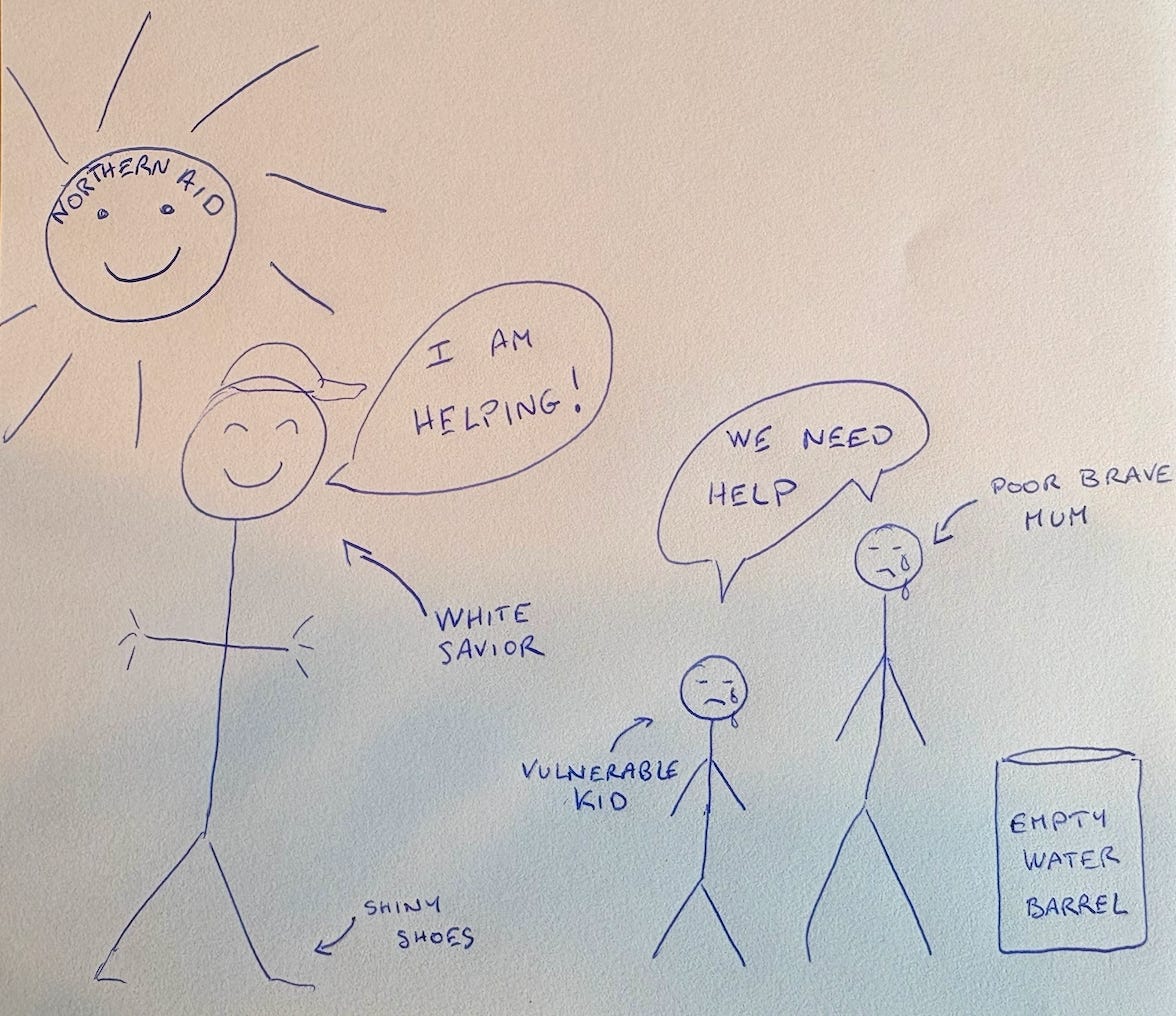
Let me walk you through the photograph (if my drawing wasn’t clear enough).
African child. Bare feet optional. Dust preferable. Expression: somewhere between sad and resilient. Mother in background. Water container if available.
Absolutely no accountant, engineer, lawyer, civil servant, researcher or mildly irritated teenager scrolling TikTok anywhere in the frame.
We have become so accustomed to this visual vocabulary that we barely see it anymore.
Africa suffers → Europe discusses → Europe gives → Africa receives → Africa provides the photograph → Europe writes the caption → Europe is content.
And this has a name: poverty porn. It describes representations of poverty designed primarily to provoke an emotional reaction (pity, guilt, horror) and often, eventually, a donation.
The problem is not that the suffering depicted isn’t real. Very often, it is devastatingly real. The problem is what disappears around it.
History? Politics? Responsibility? Agency? Names? Power?
People become evidence of suffering rather than people who happen to be suffering.
And, unfortunately, there is a very practical reason organisations keep doing this: it works. A 2024 study in the Journal of Philanthropy and Marketing interviewed fundraising managers at 22 NGOs in Ghana; they described poverty-porn imagery as effective, and the ethical trade-off as justified by the money raised. The more helpless someone looks, the more compelling the appeal can become.
Which creates a rather grotesque communications problem: Agency is morally preferable. Helplessness may be more marketable.
We Have Been Here Before
If you want the grandfather of this visual tradition, you could start with Band Aid.
In 1984, Do They Know It’s Christmas? mobilised an extraordinary response to famine in Ethiopia. It raised money. It helped people. It also helped cement an extraordinarily durable image of an entire continent: barren, starving, helpless, waiting for rescue. Forty years later, British-Ghanaian musician Fuse ODG was still arguing that the imagery and narrative had done lasting damage. He had already refused to participate in the 2014 version because of how Africa was portrayed.
I know, I know. This was forty years ago. I'm old. Things have changed. We've evolved. We would never - hem. Would we?
In 2017, a Comic Relief film followed Ed Sheeran to Liberia, where he met children living in difficult circumstances. You know the type of film. We have hundreds. A celebrity lands, a camera crew follows, and for four minutes we watch Ed discover that poverty is sad. Look at him listening. Look at him crying. The children are cute, the children smile, and the children exist in this film for exactly one purpose: to be the emotional backdrop against which Ed is filmed having feelings. Their poverty is the set. Their smiles are the lighting. Ed Sheeran is the story.
Seriously. F*ck this sh*t.
Somewhere between the drone shot and the piano soundtrack, actual human beings living through an actual crisis got recast as extras in a film about our compassion. I feel acute nausea every time the genre reinvents itself, which it does, reliably, every fundraising season.
The Radi-Aid awards—created specifically to challenge stereotypical development fundraising—gave it their “Rusty Radiator” award and criticised it as poverty porn and poverty tourism. And guess what? Ed Sheeran’s film won it. Poor, dear Ed. I mean he’s cute. Keep being in love with the shape of her (hello, Ed Sheeran fans), but please stop trying to show how in love you are with the shape of Africa.
None of this means the original participants wanted to humiliate Ethiopians. And the problem isn’t that Ed Sheeran secretly hates Liberian children.
That’s precisely what makes the case interesting. Good intentions and harmful representation can coexist perfectly well.
International development would collapse overnight if they couldn’t.
To be fair, Comic Relief announced in 2020 that it would stop sending celebrities to Africa to make appeal films and would instead put greater emphasis on locally made storytelling.
Turns out Africa contained storytellers all along.
Who knew.
But the Camera Is Only the Beginning
It would be convenient if poverty porn were simply a communications problem.
We’d just hire better photographers, write ethical guidelines (oh we love that, writing ethical guidelines), obtain consent.
Problem solved.
Unfortunately, I think something deeper is happening. Photography is only one part of a much larger economy in which some people’s lives become raw material for other people’s work. And I know this because I worked in that economy. I’ve worked in international development for more than fifteen years. I’ve conducted consultations. I’ve interviewed communities. I’ve written assessments. I’ve asked people about land dispossession, livelihoods, discrimination, conflict, poverty and their fears about projects being imposed on them.
Recently, I became a researcher. So naturally I started interviewing people again. Just with better references.
At some point, you have to notice the pattern. The photographer extracts the image. The journalist extracts the story. The researcher extracts the knowledge. The consultant extracts the “stakeholder input.” The NGO extracts the testimony.
Everyone leaves with something. The community remains where it was.
Research Has Its Own Poverty Porn
Academia has nicer vocabulary for this.
We call it: data collection. It’s neat. Convenient. We collect data the way one picks mushrooms: it was just growing there, apparently belonging to no one.
“I collected data” sounds considerably better than “I flew somewhere poorer than where I live, asked people to explain their lives to me, transformed what they said into intellectual output, published it under my name and advanced my career.”
(Actually. I did not. The “community” I observed and interviewed were people working inside and outside international organizations. So I kinda dropped the colonial hat and white vest to wear jeans and observe my own indigenous community of northern experts).
There are important differences, obviously. Ethical research can be collaborative, reciprocal and politically useful. Communities can actively want research. Documentation can support land claims, expose abuses and challenge powerful institutions.
But none of that makes the extractive question disappear.
Who defined the research question? Who designed the methodology? Who was paid? Who owns the recordings? Who interprets what was said? Who becomes an author? Who gets cited? Who flies to the conference?
And perhaps my favourite:
Who gets called the expert afterwards?
Journalism Has a Version Too
Journalism faces the same dilemma.
A disaster happens. A journalist arrives. There is limited time. Editors need a story. Readers need a human angle.
And so we find: the grieving mother, the destroyed home, the displaced child, the farmer staring at dead crops.
Again, these people exist. Their stories matter. Journalists absolutely should document suffering.
But imagine trying to understand France exclusively through photographs taken during riots, floods and funerals. Technically, every photograph might be true. Collectively, you would have produced something profoundly false.
That is what representation does. A stereotype doesn’t necessarily require lies. Sometimes it is simply the endless repetition of one particular truth.
Climate Has Inherited the Same Gaze
And this is where poverty porn becomes a climate justice issue.
Think about the visual language of climate change.
Africa? drought.
Bangladesh? flooding.
Pacific islands? disappearing.
Indigenous Peoples? standing in forests.
Women? carrying water.
Children? looking concerned.
Meanwhile, stories on wealthy countries get: electric vehicles, wind turbines, scientists, engineers, green buildings, innovation.
Apparently climate change has divided humanity into two professional categories:
people who suffer from climate change
and
people who solve climate change.
This matters because images don’t merely illustrate our understanding of the world: they produce it.
If communities in the Global South appear repeatedly as vulnerable populations, beneficiaries and victims, then it becomes perfectly logical that someone else should design the solutions.
Someone else (preferably from the solving category) has the technical expertise, controls the funding, writes the project, measures the impact, photographs the beneficiary afterwards.
The image and the institution reinforce each other.
And Then We Call Them “Voiceless”
One of my favourite (no) expressions in development is: “giving voice to the voiceless.”
How generous of us. Curiously, the supposedly voiceless usually have voices. Often quite loud ones. What they lack is access to our microphone. That's not a speech impediment. That's a door policy. That’s different. We confuse lack of institutional power with lack of agency. Then we arrive, record someone’s testimony (preferably someone whose discourse goes our way because, hey, why not?), translate it into donor-compatible English, put it into a report and announce that we have amplified their voice. Whose voice got amplified? And whose organisation got funded?
This isn’t merely rhetorical.
In 2016, major humanitarian actors committed through the Grand Bargain to channel at least 25% of humanitarian funding to local and national responders “as directly as possible.”
Years later, the numbers remain striking. In 2023, Development Initiatives found that Grand Bargain signatories provided just 0.6% of their funding directly to local and national actors based on independently verifiable data. Count indirect funding too (money that passes through an international intermediary first) and you get all the way to 1.9%. Read that again. 1.9%. The target was 25%.
The international humanitarian system is considerably better at localizing people’s stories than localizing its money.
Narrative Extractivism
This is why I’ve started thinking that “poverty porn” isn’t quite enough to describe the problem. What we’re looking at is narrative extractivism.
Traditional extractivism takes something valuable from somewhere and moves the value elsewhere.
The gold leaves the mine (we've agreed this is bad). The timber leaves the forest (very bad). The oil leaves the ground (we march about this one). The story leaves the village (we… put it in our annual report).
Narrative extraction actually follows a strangely similar geography.
A story leaves a community. A photograph leaves a family. Knowledge leaves a village. A testimony leaves a survivor. And somewhere else, value is created: donations, attention, publications, institutional legitimacy, careers, impact reports.
Sometimes substantial benefits flow back, sometimes they don’t, but the crucial question is: Who controls the transformation of experience into value?
Because extraction isn’t defined simply by taking something. Exchange exists everywhere. What makes a relationship extractive is the distribution of control, ownership and benefit.
And Yes, This Makes My Own Position Uncomfortable
I can’t write this article pretending I’m standing outside the system pointing at the bad NGOs. I am the NGO person. I am the consultant. I am the researcher. I even was the journalist at one point. I’ve been the person arriving with the questions.
I’ve written about Indigenous knowledge. I’ve published research based on things people told me. I am currently writing this newsletter partly because those experiences gave me something to say.
So I don’t get to conclude: STOP EXTRACTING STORIES, EVERYONE.
That would be wonderfully convenient. Instead, I have to ask the considerably more annoying question:
What would a non-extractive relationship actually look like?
And I don’t think the answer is simply “never take photographs”, nor is it “Western researchers should never work in Africa”, nor “journalists shouldn’t report suffering.”
There are atrocities that desperately need documenting. There are communities actively asking journalists to tell their stories. There is research that redistributes power. There are NGO campaigns developed collaboratively and respectfully. There is a need to raise money (still, not all ends justify the means, sorry Machiavelli. Who, by the way, never actually said that. Even his quote was taken out of context and repackaged for mass circulation. There's a lesson in there somewhere.). And there are photographs of suffering that have changed public opinion and political history.
The camera isn’t inherently colonial. Neither is the notebook.
The question is who controls them.
Imagine someone is receiving emergency food. An organisation providing that food asks: “Can we photograph you?” They say yes. Technically: consent. But what exactly was the power relationship in that interaction? Could they comfortably say no? And did they consent to being transformed from a person currently experiencing hardship into a generic symbol of African poverty?
There is a difference between permission and power. Climate justice should probably care about both.
So, Was Burkina Faso Right?
I don’t know that a government prohibition alone can resolve any of this. Ethical representation cannot simply be legislated into existence, and regulation of NGOs and civil society deserves scrutiny — especially, as noted, from a government with its own strong interest in controlling who holds the camera.
But Burkina Faso has put its finger on something the international aid system has spent decades trying to resolve through ethical storytelling guidelines: receiving help should not cost you your dignity.
And perhaps we should go further. Receiving help should not automatically make your face public property. Living through climate change should not condemn you to performing vulnerability for the people financing adaptation. And being poor should certainly not require becoming somebody else’s content.
Here is the visual experiment I’d like to try.
The next time we illustrate climate injustice, photograph the people responsible. Not exclusively the people experiencing its consequences. Photograph the boardroom (I know, the lighting is terrible). Photograph the fossil fuel lobbyist (ugly, or at least I like to think so). Photograph the investment committee (Boring - power is unphotogenic, and that’s its camouflage). Photograph the minister approving the mine (yes, him). Photograph the luxury development built on a floodplain. Photograph the frequent-flyer lounge.
Photograph us.
Imagine a fundraising campaign saying: THIS MAN’S INVESTMENT PORTFOLIO NEEDS YOUR ATTENTION.
I’d donate.
Perhaps one reason our climate imagery remains politically weak is that we have become extremely good at visualising vulnerability and remarkably bad at visualising responsibility.
A child standing in floodwater makes climate change emotional. A series of political and financial decisions made fifteen years earlier might explain why that child is standing there.
Justice requires both photographs.
Really great piece! You pick up the argument where it left off and pull at several more threads and explore new angles. I worked in this space for many years and I love your idea to photograph the boardroom. I bet a brave agency could develop an impactful campaign. One thing I used to notice during the early disaster response phase was that many colleagues were using the “consultation fatigue” argument to not go and ask communities about their needs and opinions. I felt at the time this was due to a) everyone was picking the same small groups of people because they were easily accessible and b) they really didn’t want to talk to them and it was a good excuse
Thanks for this. And then there are also the people who cause climate change. Amazingly, the people who suffer also contribute to solving it.