The Illusion of Knowing (And Why I’m Annoyed at Myself Too)
Less swagger, more listening, better politics?

Hi. If you’re here, chances are you care about climate change and you also… know things.
Or at least, you think you do.
Same.
We read articles. We follow smart people on Substack. We scroll through doom-laden infographics while waiting for the kettle to boil. We accumulate “facts” like spare tote bags: too many, vaguely useful, never quite enough to change anything.
We’re so saturated with climate content that we confuse information with understanding.
And that’s not just you. That’s me.
The performance of knowing
I’ve spent 15+ years in climate, development, Indigenous rights. I’m doing a PhD. I’ve sat in meeting rooms that smelled like old coffee and power imbalance. I’ve taken notes in villages on the edge of the Congo rainforest, believing my bullet points were important.
And still, half the time I realize: I’m operating on headlines. On snippets. On a shaky collage of other people’s work and my own assumptions. I think I “know,” but I’m just better at performing knowing. I open my mouth and out comes “rights-based approach.” And silently I pray no one asks: “Okay—but how exactly will this work?”
Tiny story (in which I am the fool)
At a meeting with villagers, I once explained “rights-based conservation” with the grace of a TED Talk.
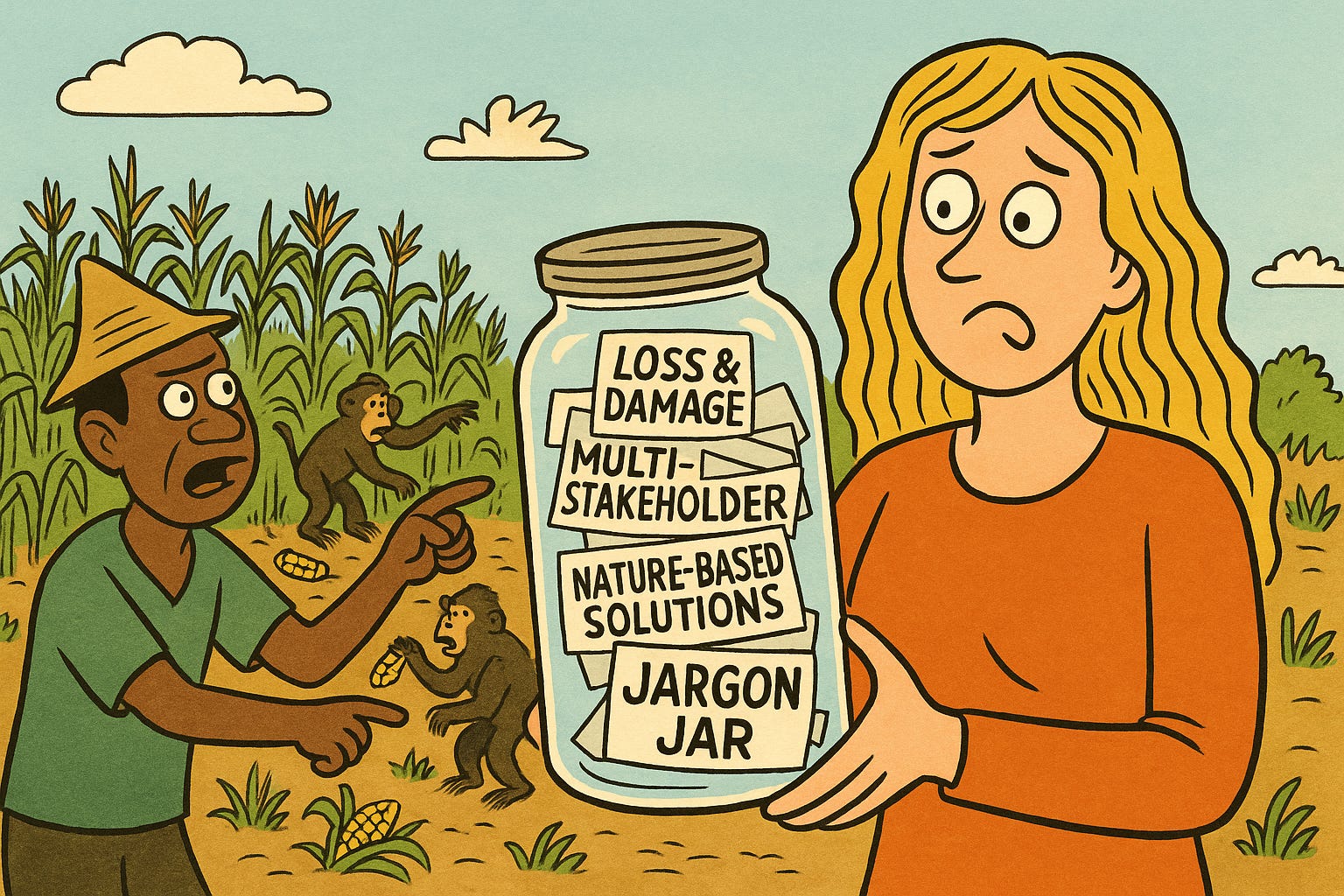
A woman from a lake community listened politely and said: “Great. How do we deal with the baboons savaging our fields without killing them?”
I had ideas. She had the problem that mattered.
I went back to the project owners. Baboons were nowhere in their theory of change. They did not appear as an issue. They got sidelined. Killing them was still a crime.
Here’s the problem:
The climate scene rewards performance. In conferences, we nod sagely when someone mentions “loss and damage” or “nature-based solutions,” even though our mental image is a fuzzy amalgam of the last policy brief we skimmed. We parrot phrases like “multi-stakeholder engagement” or “just transition” without asking ourselves: Could I actually explain this, clearly, without hiding behind jargon? What does it mean for people? Concretely?
This is how the illusion works:
Shiny phrases pass as progress.
Real issues vanish into jargon.
Communities wait for results while we congratulate each other for fluency.
When “Knowledge” Misses the Point
It’s not just me. Entire projects get lost in the illusion too.
Example one: a wind turbine project on Indigenous lands. Communities were asked a series of questions to assess potential side effects. Their main concern? That turbines would disrupt their dreams, usually carried by the wind. Dreams are not a minor issue—they’re how people make sense of life, health, and relationships. But there was no tick-box for “dreams affected.” The concern was ignored. The fear remained.
Example two: external consultants trekked to a rainforest village to “explain” the carbon market. They left satisfied—“capacity built,” “information mainstreamed.” Communities, though, were puzzled. They already had a market in their village. Why would they need another one? And if air was being packed up and sold far away, what would they breathe?
What looked like progress on paper was, in reality, confusion layered on dispossession. A shiny knowledge-based “solution” utterly detached from context.
The Myth of Capacity Building
And then there’s the darling of every donor report: capacity building.
The idea is simple. Locals supposedly lack “capacity.” Western institutions, armed with PowerPoints, will transfer it to them. But capacity isn’t a USB stick you can plug in. Communities already know. They manage land, organize harvests, heal the sick, raise children, survive floods, tell stories, govern disputes.
So what exactly are we “building”? Often, it’s not capacity—it’s compliance. The ability to fill forms, speak jargon, mirror donor logic. A postcolonial rebranding of ignorance: your knowledge doesn’t count until it sounds like ours.
Capacity building assumes a one-way flow of expertise: from North to South, expert to community, knower to ignorant. But in practice, what gets transferred is usually paperwork, not power.
If anything, the real work is unbuilding: dismantling the arrogance that says knowledge only matters when it comes with a logframe.
The Jargon Jar (play along at home)
“Loss and damage” — €1 unless you can explain it to your aunt in two sentences without the word “mechanism.”
“Nature-based solutions” — €1 unless you can say who owns the land and who gets paid.
“Multi-stakeholder process” — €1 unless you can name three stakeholders who were not in the room and why.
So yes, I am exasperated with the illusion of knowing. Yours, mine, the entire movement’s. I think I’ve particularly started hating the know-it-all, the Bretts’, the so-confident-armed-with-statistics-powerpoint-masters. Swinging their charts like medieval broadswords, cutting through nuance and leaving the rest of us ducking under the table. They’re like Nerf guns at a funeral: loud, ridiculous, and missing the point.
But here I am, still sharing what I “know,” still probably missing half the picture, still a fool for thinking my words might help.
Knowing Less, Deeper
I’m not saying we need to know everything. That’s impossible.
I’m saying we could choose to know less—but deeper. Read the boring bits. Sit with the uncomfortable questions. Resist the dopamine hit of the next micro-insight and follow one thread until it frays.
Because climate justice is not trivia night. It’s slow work:
connecting dots, naming who benefits, remembering that every statistic has an address.
Justice check: does my “knowing” change anything for someone with less power?
Tenants during heatwaves: can they cool their home without breaking the law or the bank?
Farmers promised climate finance: do they see cash, or only consultants?
Forest communities: who decides what counts as “protection”—and whose knowledge counts as expertise?
If my answer is “I’m not sure,” that’s not a failure. It’s the work.
Your 10-Minute Practice (I’m doing it too)
Pick one thing you think you know (carbon markets, heat plans, “just transition”).
Explain it out loud like you would to a cousin who couldn’t care less. No acronyms. Two minutes.
Where you stumble, that’s your study plan. Read one long thing. Call one person who actually does it. Ask, “What do people always get wrong?”
End with one justice question: Who pays? Who decides? Who benefits? Who’s missing?
Do one tiny action that follows: email a city councilor, show up at a tenant meeting, send a stipend to a community expert you just learned from, unsubscribe from one performative panel and attend a boring-but-real budget hearing.
Fool’s honor.
The Takeaway
Yes, I’m still annoyed at myself. Still missing half the picture. Still hoping words can help.
But maybe the trick is less performance, more practice.
Ask better questions. Listen longer. Name the power.
Climate justice doesn’t need more clever phrases.
It needs fewer illusions, sharper questions, and the courage to say:
“I don’t know—but I’m here to learn.”
Marine
This is exactly right. The biggest deceit in a conversation about climate change is the illusion that communication has taken place.
(I am trying to remedy that, one quirky climate story at a time.)
Truly brilliant and needed. Thank you so much.